
The Twelve Keys to Investing
A proven strategy
Why invest
Everything we own is in fact invested. When you own something, whether a pair of shoes or cash in your bank account, that thing corresponds to a value that fluctuates with the market's appraisal. The price of a pair of shoes, say 150 euros, is the sum you have to pay in the shop to buy it. But if you decide to resell it, its market price will probably have changed by the time you walk out of the shop: it will likely be lower if potential buyers place value on the experience of buying in a shop, on the pleasure of being the first owner, or on the guarantee an established retailer provides, against counterfeiting for example. Conversely, the price of your shoes could be higher as you leave the shop if they are a limited edition, much sought after, reserved for a short list of privileged customers. As for the money you hold in your bank account, in which currency is it denominated? Its value in dollars or in gold has already changed in the time it took to read this sentence.
In reality, every good you own is an investment whose market price is constantly changing.
Value differs from price
Value differs from price. This idea goes back to Antiquity, notably to the Nicomachean Ethics of the philosopher Aristotle.
The value of a good or a service varies with each individual's own appraisal. The difference between the market price and the value you assign to it is what allows you, as a buyer, to make a profit.
Imagine that you like a pair of shoes. You spotted it somewhere and it appeals to you so much that you would be willing to spend up to 200 euros to own it. This means that at 200 euros, you are indifferent between keeping your money and buying those shoes. Above that amount, you do not buy them; below it, you make a gain. For 150 euros, you enjoy a pleasure or a usefulness that you value at 200 euros. Your gain is therefore 50 euros.
The price is set according to the value that certain people assign to the good. Price setting is not a democratic referendum: a small number of people is sometimes enough to determine it. For example, a painting by the artist Rothko can change hands for several million dollars, while most people in the world have never heard of this artist and would not even be willing to pay ten dollars to own one of his canvases.
Keep these two examples in mind, the pair of shoes and the Rothko painting, because the stock market works in a similar way.
Fertile and non-fertile assets
A master painting, a gold coin and a classic car have points in common:
- Their owners derive a sensory pleasure from them (sight, touch);
- Their value may potentially rise over time, which allows these objects to be classed as assets;
- These assets do not reproduce and generate no income, just like currencies or commodities.
Their only potential gain lies in the possibility of reselling them for more than their purchase price: a capital gain, not an income (unless you rent out your classic car).
Yet some goods, or assets, are fertile. This is where the notion of compounding comes in.
These are precisely the assets we want to own. We value them all the more when they produce many other goods, and do so regularly.
When you buy a share of the company LVMH, you become the owner of vineyards, machines and leather-stitching machines. These assets in turn produce other goods: champagne and handbags, which LVMH exchanges with its customers for euros or dollars.
Once costs, charges and taxes have been deducted, a profit remains. It allows the company to invest in new means of production, and possibly to reward its shareholders in the form of dividends, which you can use to buy more LVMH shares.
By contrast, if you decide not to invest and to keep your euros or your Swiss francs in your bank account, all you own is a piece of information written on a hard drive.
Since they are no longer backed by gold, that is, by the guarantee of being exchanged for gold by the bank that issues them, modern currencies derive their value exclusively from collective trust: we accept a banknote or a bank deposit in exchange for an effort because we are convinced that another person will accept our currency in exchange for a good or a service.
Currencies produce nothing; they are sterile and lose value over the long term.
Just as energy naturally degrades over time and is hard to store without losses, the value created by human work and effort (in the form of goods, services or savings) tends to deteriorate or to lose purchasing power when one tries to keep it over the long term; this is the phenomenon that shows up notably as inflation, where money gradually loses its value, making accumulated savings less effective at buying the same things in the future.
A machine that makes handbags, on the other hand, is fertile. A gold mine is fertile; a gold bar is sterile. In investing, what we look for above all is fertility.
Money must have offspring.
Compounding
“Compound interest is the eighth wonder of the world. He who understands it, earns it; he who doesn't, pays it.” This quotation is often attributed to A. Einstein.
What is capitalism? It is nothing more than restraining oneself in order to save, buying a means of production that generates a return, and reinvesting that return indefinitely. When you buy a share, you are the co-owner of a means of production.
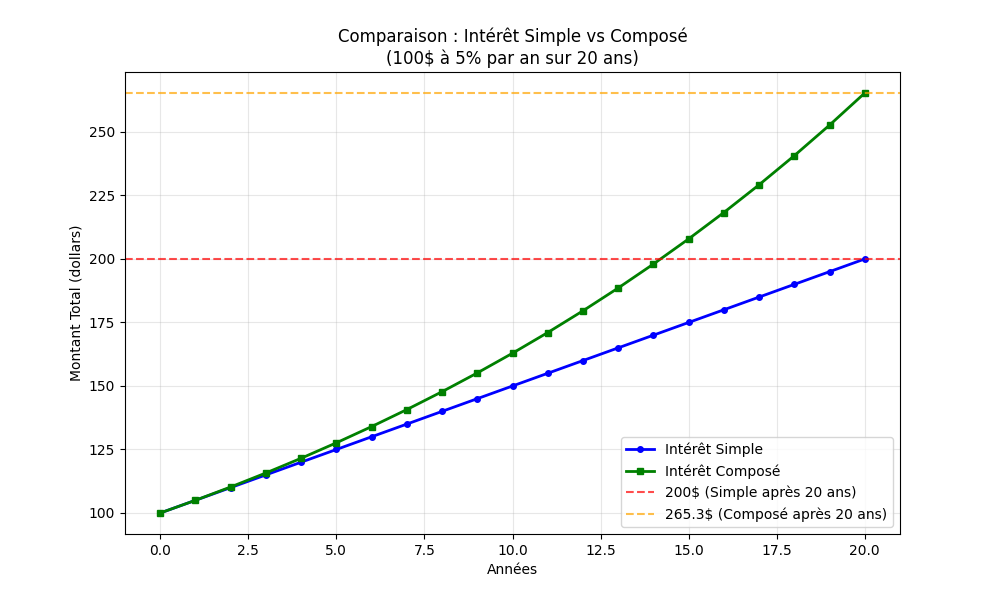
Reinvesting gains is essential, because it allows exponential growth. For example, 100 dollars invested at 5% earn 5 dollars a year. Without reinvestment, after 20 years, you will have 200 dollars. But if you reinvest those 5 dollars each year, at the same rate, you will reach about 265 dollars after 20 years.
How does the reinvestment of gains work in the case of a company?
Reinvestment is the source of the compounding effect. It is like a snowball you set rolling: it grows with every turn. The slope is the same, but because the ball is bigger, it picks up more and more snow.
Compounding at the level of a company
Net profit (or net income) can be reinvested in two distinct ways.
- First, through the dividend. Part of the profit can be distributed to shareholders in the form of dividends. The shareholder is then free to use it as they wish. If they use the dividends to buy more shares of the same company, then compounding takes place at the level of the investor.
- Second, through reinvestment by the company. The share of profit that is not distributed is retained and reinvested directly by the company in its business. If these investments are effective, they increase the value of the company, which translates into a rise in the share price and a potential capital gain for the shareholder.
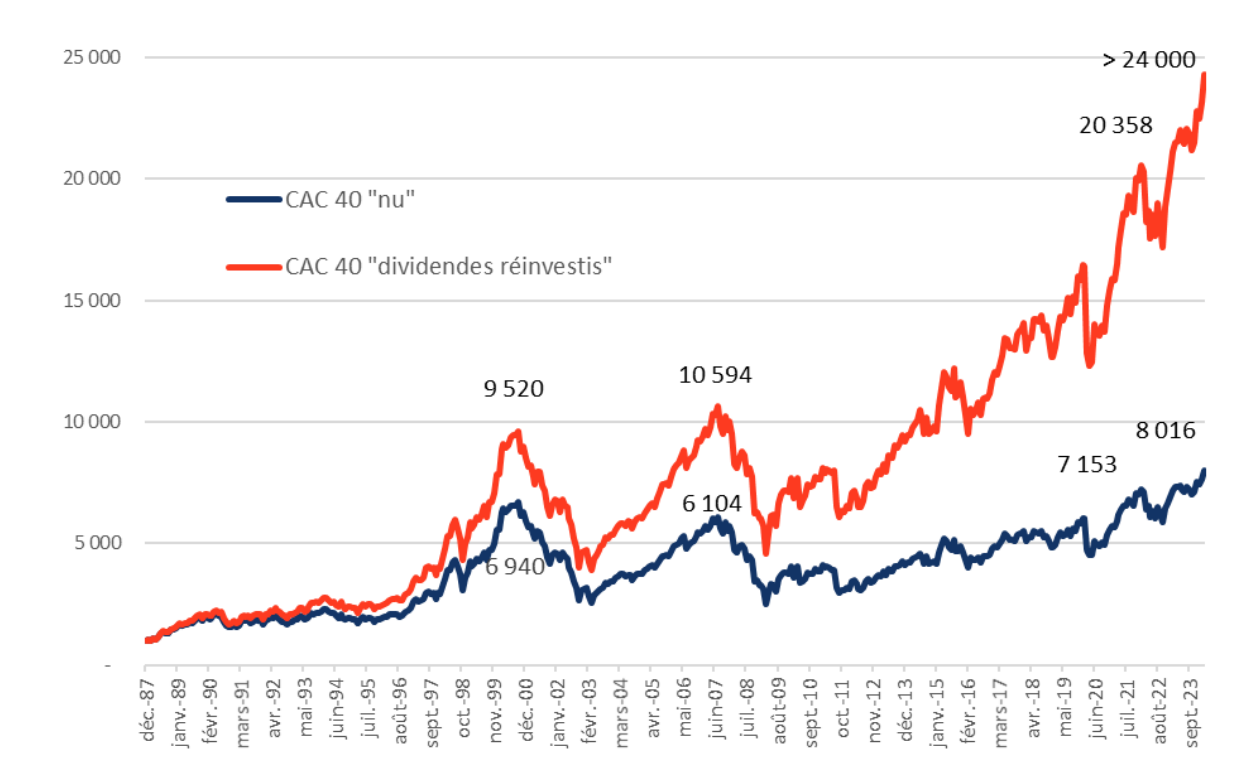
A company that pays no dividends is therefore not necessarily less attractive: it may be favouring long-term value creation over immediate income. In the chart below, the French stock market index, the CAC 40, is shown with and without reinvestment of dividends. You can see the multiplier effect of reinvesting dividends.
At what level of wealth can we start spending our gains?
If possible, never. If you spend your gains, you kill a hen that could have laid eggs for a long time.
To understand this logic of saving, it is worth observing how it developed from the sixteenth century in Protestant societies. Their religious logic is defined by a personal restraint on spending, a voluntary renunciation of comfort, pleasure and display, coupled with a will to be useful to one's community. Restraint leads to saving, and the will to serve leads to investing in tools of production. When you combine these two notions, you accumulate wealth. Here is what Max Weber observes in The Protestant Ethic and the Spirit of Capitalism:
When such a brake on consumption is combined with such an unbridled pursuit of gain, the practical result is obvious: capital is formed through ascetic compulsory saving. It is clear that the obstacles standing in the way of consuming what had been acquired favoured its productive use as capital to be invested. Need one add that the strength of such a fact escapes any exact measurement? In New England the connection is so plain that it did not escape the eye of a historian as discerning as Doyle. But in Holland, a country which was nevertheless subject to strict Calvinism for only seven years, the absolute plainness of life of the most strictly religious circles, which went hand in hand with the possession of enormous wealth, carried the taste for capitalist accumulation to excess.
The book quotes Benjamin Franklin:
Remember, that money is of the prolific, generating nature. Money can beget money, and its offspring can beget more, and so on. Five shillings turned is six, turned again it is seven and threepence, and so on, till it becomes a hundred pounds. The more there is of it, the more it produces every turning, so that the profits rise quicker and quicker. He that murders a crown, destroys all that it might have produced, even scores of pounds.
It is in fact not unusual, in societies influenced by this Protestant ethic (notably the United States), for these same savers, once they have reached comfort or fortune, to become active philanthropists: after a life spent methodically accumulating capital, they often seek to redistribute its fruits to support education, research, culture or social causes.
Buying a fertile asset at a price below its value
Recall the example of Rothko's paintings, whose price is determined by a small number of buyers and sellers. The same goes for shares on the stock market: only a tiny fraction of a company's total market value changes hands each day, often less than 1%.
And what if their price setting were not right? While the value of an asset that produces no income, such as a painting or a pair of shoes, remains highly subjective, because supply and demand often depend on emotional factors or passing fashions, for an asset that generates cash an arsenal of objective valuation tools is at our disposal. Among the main ones:
- Discounted future cash flows
- Discounted future dividends
- Discounted future residual income
- Comparison of multiples: Price/Earnings, Price/Book Value, EV/EBITDA, etc.
By comparing our estimate of a company's real value with its market price, we can determine whether we are buying it at a reasonable price. Certain periods, notably financial crises, offer exceptional opportunities: fear and irrationality take over, prices abruptly disconnect from economic reality, and the best companies find themselves temporarily marked down. At such moments, the investor Warren Buffett said he felt “like an oversexed guy in a whorehouse” (Forbes, 1974), so attractive are these opportunities.
In short, the aim is to buy fertile assets, that is, assets capable of producing cash in the future, at a fair price, or ideally at a very attractive price when the opportunity arises, while reinvesting the dividends to maximise the multiplier effect.
As we have stressed, what matters to us is “future” results. We look for companies that deliver a high return from the moment we become their owners, that is, in the future.
How to invest: our strategy
1. Predicting the future with probabilities
We project a range of different scenarios, each with its own probability of occurring. To estimate future results, we rely on the stability of past results. This is a mechanism we often apply without being aware of it.
Receive the complete book free
Enter your email address: the download link appears straight away. By signing up, you agree to also receive our analyses and offers by email; you can unsubscribe in one click.
Your email address is used only to give you access to the book, then send you our analyses and offers. It is neither sold nor passed on to third parties. You can unsubscribe at any time, or ask for your data to be deleted. Privacy Policy